
Keywords
Humboldtian university
Central Europe
academic capitalism,
reforms of higher education
How to Cite
Number of views: 231
Number of downloads: 141
Abstract
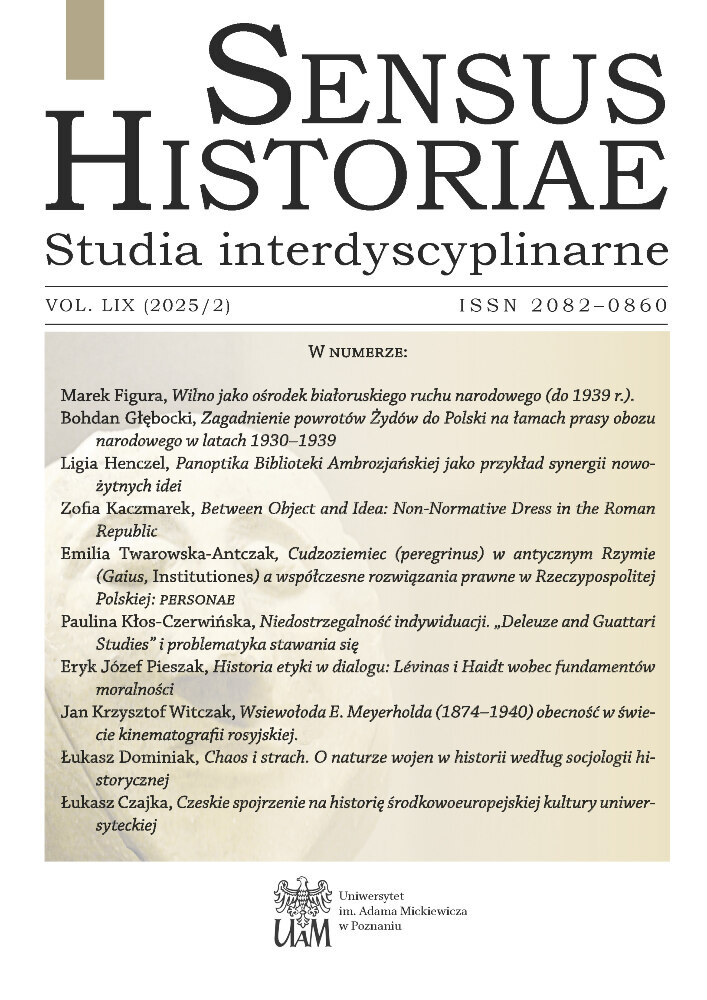
Lukáš Fasora and Jiří Hanuš, two Czech historians, demonstrate in their research that the Central European university culture, in countries such as the Czech Republic, Slovakia, or Poland, often developed through difficult struggles against the overpowering influences of German or Russian culture. An example of such an influential idea is the Humboldtian vision of the university, advocating the creation of an autonomous academy free from political, religious, and economic pressures. In the 20th century, the turbulent history of Central European universities revealed two threats to this ideal of academic culture. The first was communist ideology, which destroyed freedom of speech and the autonomy of scientific research. The second challenge for today’s universities are the current higher education reforms, which pave the way for the emergence of corporate institutions of academic capitalism.
References
Diatelová Irena M. (2024). MU micro-credentials will revolutionise professional education. Em.muni.cz, 20 czerwca 2024 [https://www.em.muni.cz/en/news/17475-mu-micro-credentials-will-revolutionise-professional-education (dostęp: 11.02 2025)].
Fasora Lukás, Hanuš Jiří. (2019). Myths and Traditions of Central European University Culture. Brno/Praga: Masaryk University Press & Karolinium Press. DOI: https://doi.org/10.5817/CZ.MUNI.M210-9413-2019
Fiala Martin. (2024). Scrutone Rapid Podcast - Martin Fiala. Youtube.com, 8 maja 2024 [https://www.youtube.com/watch?v=7LNo-kYg3RE (dostęp: 10.02.2025)].
Iwanicki Juliusz. (2012), Transformacja procesu sekularyzacji. Próba kategoryzacji. „Przegląd Religioznawczy” nr 4(246): 25-34.
Sosnowska, Paulina. (2012). Idea niemieckiego uniwersytetu: mit Humboldta? „Teraźniejszość - Człowiek - Edukacja: kwartalnik myśli społeczno-pedagogicznej” nr 4(60): 127-142.
Vacinová Lenka. (2023). Professor Růžena Vacková. Ukar.ff.cuni.cz, 28 stycznia 2023 [https://ukar.ff.cuni.cz/en/about-us/history/ruzena-vackova/ (dostęp: 11.02.2025)].
License
Copyright (c) 2025 Łukasz Czajka

This work is licensed under a Creative Commons Attribution-ShareAlike 4.0 International License.