
Abstrakt
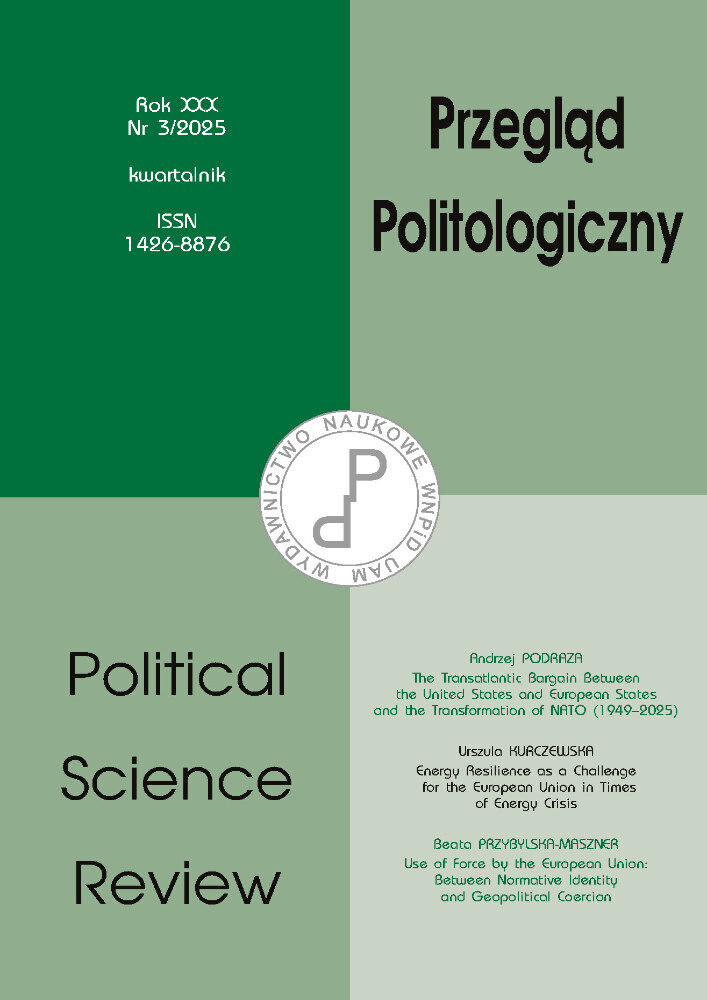
Celem artykułu jest analiza układu transatlantyckiego między Stanami Zjednoczonymi a Europą w perspektywie historycznej od momentu powstania NATO w 1949 r. do rosyjskiej agresji na Ukrainę w 2022 r. NATO jest określane jako transatlantycki układ, co oznacza, że Stany Zjednoczone zobowiązują się pozostać zaangażowane w europejskie rozwiązania dotyczące bezpieczeństwa, a Europa wnosi znaczący wkład w system zbiorowej obrony. Układ transatlantycki był kluczowym fundament partnerstwa między Stanami Zjednoczonymi a Europą podczas zimnej wojny, kiedy Związek Radziecki stanowił namacalne zagrożenie. Po zakończeniu zimnej wojny pojawiło się wiele problemów związanych z transatlantycką umową, ale atak Rosji na Ukrainę w 2022 roku podkreślił znaczenie NATO jako sojuszu obronnego. Transatlantycka umowa może jednak zostać zakwestionowana przez transakcyjne i unilateralne podejście prezydenta Donalda Trumpa, który powrócił do władzy w 2025 roku.
Bibliografia
BBC News (2005, 25 April), Putin deplores collapse of USSR, http://news.bbc.co.uk/2/hi/4480745.stm.
Brattberg E. (2021), Transatlantic relations after Biden’s first 100 days, https://carnegieendowment.org/2021/05/06/transatlantic-relations-after-biden-s-first-100-days-pub-84472.
Collinson S. (2025, 19 February), Trump’s slam of Zelensky is a remarkable moment in US foreign policy, https://edition.cnn.com/2025/02/18/politics/donald-trump-putin-ukraine-analysis/index.html.
Costigliola F. (1984), The Failed Design: Kennedy, de Gaulle, and the Struggle for Europe, “Diplomatic History”, 8(3), pp. 227–251 DOI: https://doi.org/10.1111/j.1467-7709.1984.tb00410.x
Cronberg T. (2017), Nuclear multilateralism and Iran. Inside EU negotiations, Routledge, Abingdon–New York. DOI: https://doi.org/10.4324/9781315269962
Dempsey J. (2017), NATO’s Eastern flank and its future relationship with Russia, Carnegie Endowment for International Peace, Washington.
Hadeed M., Sus M. (2020), Germany and NATO’s Eastern flank. Conclusions for Poland, Instytut Europy Środkowej, Lublin.
Hyde-Price A. (2016), NATO and the European security system, in: Theorising NATO. New perspectives on the Atlantic Alliance (pp. 22–40), eds. M. Webber, A. Hyde-Price, Routledge, Abingdon. DOI: https://doi.org/10.4324/9781315658001-2
Joint Declaration. British-French Summit. St-Malo, 3–4 December 1998 (2001), in: From St-Malo to Nice. European Defence: Core Documents (pp. 8–9), ed. M. Rutten, Institute for Security Studies of the Western European Union, Paris.
Kanet R. E. (2022), Russian strategic culture and renewed conflict with the West, in: Russia and the world in the Putin era. From theory to reality in Russian global strategy (pp. 34–60), eds. R. E. Kanet, D. Moulioukova, Routledge, London–New York. DOI: https://doi.org/10.4324/9781003190417-2
Keukeleire S., Delreux T. (2014), The foreign policy of the European Union, Palgrave Macmillan, Basingstoke. DOI: https://doi.org/10.1007/978-1-137-02576-0
Kiel Institute for the World Economy (2025), Ukraine support track. A database of military, financial and humanitarian aid to Ukraine, https://www.ifw-kiel.de/topics/war-against-ukraine/ukraine-support-tracker/.
Kiwerska J., Kubera J., Morozowski T. (2017), Prospects for transatlantic relations, in: Trump presidency and transatlantic relations (pp. 81–86), ed. J. Kiwerska, Instytut Zachodni, Poznań.
Mahan E. R. (2002), Kennedy, de Gaulle, and Western Europe, Palgrave Macmillan, Basingstoke–New York. DOI: https://doi.org/10.1057/9781403913920
Mearsheimer J. (1990), Back to the future. Instability in Europe after the Cold War, “International Security”, 15(1), pp. 5–56. DOI: https://doi.org/10.2307/2538981
Michta A. A. (2011), NATO’s last chance, “American Interest”, 6(5), pp. 56–60.
Nevers R. de (2007), NATO’s international security role in the terrorist era, “International Security”, 21(4), pp. 34–66. DOI: https://doi.org/10.1162/isec.2007.31.4.34
NATO (2022), NATO 2022 Strategic Concept. Adopted by Heads of State and Government at the NATO Summit in Madrid 29 June 2022, https://www.act.nato.int/wp-content/uploads/2023/05/290622-strategic-concept.pdf.
NATO (2024), Defence expenditure of NATO countries (2014–2024), https://www.nato.int/nato_static_fl2014/assets/pdf/2024/6/pdf/240617-def-exp-2024-en.pdf.
Podraza A. (1992), The Western European Union and Central Europe: A New Relationship, Discussion Paper 41, The Royal Institute of International Affairs, London.
Podraza A. (1996). Stosunki polityczne i gospodarcze Wspólnoty Europejskiej z państwami Europy Środkowej i Wschodniej, Redakcja Wydawnictw Katolickiego Uniwersytetu Lubelskiego, Lublin.
Podraza A. (2013), Addressing security threats and challenges in developing countries: a comparison of strategies of the United States and the European Union, in: North and South: the United States, the European Union, and the developing world (pp. 201–215), eds. C. Crespo, D. Garcia-Cantalapiedra, Universidad de Alcala, Alcala de Henares–Madrid.
Podraza A. (2014), Unilateralizm czy multilateralizm: porównanie strategii Stanów Zjednoczonych i Unii Europejskiej wobec wyzwań i zagrożeń bezpieczeństwa międzynarodowego, in: Współpraca transatlantycka. Aspekty polityczne, ekonomiczne i społeczne (pp. 53–68), eds. J. M. Fiszer, P. Olszewski, B. Piskorska, A. Podraza, Instytut Studiów Politycznych Polskiej Akademii Nauk, Warszawa.
Podraza A. (2015), Towards a new system of global democratic governance: the Transatlantic Security Community and the role in democracy promotion in the 21st century, in: Global challenges to the transatlantic world (pp. 73–84), eds. C. Crespo, D. Silander, D. Wallace, I. Albella, Universidad de Alcala, Alcala de Henares–Madrid.
Podraza A. (2018), The decline of the United States and the survival of NATO in the post-Cold War period – a theoretical discussion, in: Transatlantic or European perspective of world affairs: NATO and the European Union towards problems of international security in the 21st century (pp. 13–36), ed. A. Podraza, Universidad de Alcala, Alcala de Henares–Madrid.
Podraza A. (2025), Inconsistency of US policy toward Russia in the 21st century and the outbreak of war in Ukraine in 2022, “Comparative Strategy”, 44(2), pp. 201–219. DOI: https://doi.org/10.1080/01495933.2025.2456423
Politico (2025a, 12 January), Poland backs Trump push for NATO to boost defense spending to 5 percent of GDP, https://www.politico.eu/article/poland-backs-trump-calls-to-ramp-up-nato-defense-spending/.
Politico (2025b, 6 March), Trump casts doubt on NATO security agreement: ‘If they don’t pay, I’m not going to defend them’, https://www.politico.com/news/2025/03/06/trump-nato-security-agreement-00216984.
Popescu I. (2017), Emergent strategy and grand strategy, Johns Hopkins University Press, Baltimore. DOI: https://doi.org/10.1353/book.56359
Pothier F., Vershbow A. (2017), NATO and Trump. The case for a new transatlantic bargain, Atlantic Council, Washington.
Rees W. (2011), The US-EU security relationship. The tensions between a European and a global agenda, Palgrave Macmillan, Basingstoke.
Rittimann O. (2022), A revisited European security order, in: War in Europe: preliminary lessons (pp. 5–12), ed. T. Tardy, NATO Defense College, Rome.
Rohan S. (2014), The Western European Union: international politics between alliance and integration, Routledge, New York–Abingdon.
Rupp R. E. (2006), NATO after 9/11. An Alliance in Continuing Decline, Palgrave Macmillan, Basingstoke. DOI: https://doi.org/10.1007/978-1-137-05075-5
“Rzeczpospolita” (2022a, 26 March), Joe Biden: Artykuł 5. świętym obowiązkiem. Stoimy razem dzięki wartościom, wolności, https://www.rp.pl/dyplomacja/art35950901-joe-biden-artykul-5-jest-dla-nas-swietym-obowiazkiem-za-wolnosc-wasza-i-nasza.
“Rzeczpospolita” (2022b, 26 March), Joe Biden w Warszawie: Putin nie może pozostać u władzy, https://www.rp.pl/polityka/art35951221-joe-biden-w-warszawie-putin-nie-moze-pozostac-u-wladzy.
Sigalos M. (2024, 8 December), President-elect Trump says Ukraine to ‘possibly’ receive less military aid, https://www.cnbc.com/2024/12/08/president-elect-trump-says-ukraine-to-possibly-receive-less-military-aid.html.
Sloan S. R. (2020), Defense of the West. Transatlantic security from Truman to Trump, Manchester University Press, Manchester.
“The Economist” (2019, 7 November), Emmanuel Macron warns Europe: NATO is becoming brain-dead, https://www.economist.com/europe/2019/11/07/emmanuel-macron-warns-europe-nato-is-becoming-brain-dead.
The White House. Office of the Press Secretary (2009, 14 November), Remarks by President Barack Obama at Suntory Hall, https://obamawhitehouse.archives.gov/the-press-office/remarks-president-barack-obama-suntory-hall.
Turner O. (2014), The US ‘pivot’ to the Asia Pacific, in: Obama and the world. New directions in US foreign policy (pp. 219–230), eds. I. Parmar, L. B. Miller, M. Ledwige, Routledge, Abingdon–New York.
Waltz K. (1993), The emerging structure of international politics, “International Security”, 18(2), pp. 44–79. DOI: https://doi.org/10.2307/2539097
Washington’s Farewell Address to the People of the United States (1796), https://www.senate.gov/artandhistory/history/resources/pdf/Washingtons_Farewell_Address.pdf.
Licencja
Prawa autorskie (c) 2025 Andrzej Podraza

Utwór dostępny jest na licencji Creative Commons Uznanie autorstwa – Na tych samych warunkach 4.0 Miedzynarodowe.