
Keywords
Use of force
common security and defence policy
EU interventions
normative identity
Strategic Compass
How to Cite
Abstract
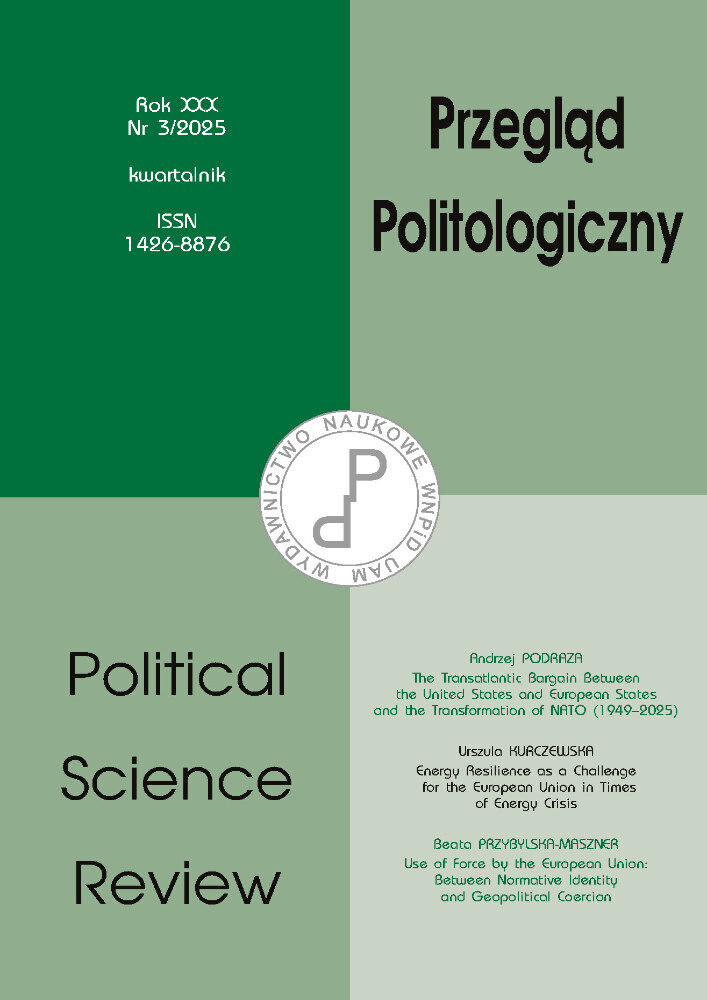
The EU is not a military organization, but it can authorize and conduct military operations under specific circumstances, often with a UN mandate. The EU’s use of force is generally focused on crisis management, conflict prevention, and maintaining international peace and security. This approach to the use of force has evolved since the 1990s. This article examines the legal regulations and political determinants of the European Union’s use of force, based on its involvement in military operations between 2012 and 2024. The author points to the evolution of the use of force by the European Union in the context of its normative identity and shifting geopolitical conditions. By juxtaposing institutional, strategic, and axiological aspects, it presents the EU’s transformation from a value-promoting entity to one capable of projecting military force. The use of force by the EU emerges not only as an instrument for defending values but also as a test of the community’s political cohesion and institutional resilience. Drawing on the concept of rational institutionalism, the author argues that in the face of specific and exceptionally difficult external challenges, actions utilizing the instrument of force become an essential component of the EU’s external action.
References
Bellamy A. J. (2015), The responsibility to protect: A defense, Oxford University Press, Oxford. DOI: https://doi.org/10.1093/acprof:oso/9780198704119.001.0001
Bickerton C. J., Irondelle B., Menon A. (2011), Security co-operation beyond the nation-state: The EU’s Common Security and Defence Policy, “Journal of Common Market Studies”, 49(1), pp. 1–21. DOI: https://doi.org/10.1111/j.1468-5965.2010.02126.x
Biscop S. (2023), War for Ukraine and the rediscovery of geopolitics: must the EU draw new battlelines or keep an open door?, Egmont – Royal Institute for International Relations.
DGAP (2022), Strategic Compass: Ambition, Achievements, and Pitfalls, German Council on Foreign Relations.
Dinstein Y. (2017), War, aggression and self-defence, 6th ed., Cambridge University Press, Cambridge. DOI: https://doi.org/10.1017/9781108120555
EEAS (2023), EUMAM Ukraine – European Union Military Assistance Mission in support of Ukraine, European External Action Service, https://www.eeas.europa.eu/eumam-ukraine.
Evans G. (2008), The responsibility to protect: Ending mass atrocity crimes once and for all, Brookings Institution Press, Washington, DC. DOI: https://doi.org/10.1353/isia.2009.0001
Fiott D. (2021), Strategic autonomy: Towards “European sovereignty” in defence?, EUISS Chaillot Paper No. 171, European Union Institute for Security Studies, Paris.
Gray C. (2018), International law and the use of force, 4th ed., Oxford University Press, Oxford.
Hall P. A., Taylor R. C. R. (1996), Political science and the three new institutionalisms, “Political Studies”, 44(5), pp. 936–957. DOI: https://doi.org/10.1111/j.1467-9248.1996.tb00343.x
Howorth J. (2014), Security and Defence Policy in the European Union, Palgrave Macmillan. DOI: https://doi.org/10.1007/978-1-137-42788-5
International Court of Justice (ICJ) (1986), Military and Paramilitary Activities in and against Nicaragua (Nicaragua v. United States of America), Merits, Judgment, I.C.J. Reports.
Juncos A. E. (2017), Resilience as the New EU Foreign Policy Paradigm: A Pragmatist Turn?, “European Security”, 26, pp. 1–18. DOI: https://doi.org/10.1080/09662839.2016.1247809
Karlsrud J., Reykers Y. (24 Jan 2019), Multinational Rapid Response Mechanisms: From Institutional Proliferation to Institutional Exploitation, eds. J. Karlsrud, Y. Reykers, 1 ed., Routledge/Taylor & Francis Group. Global Institutions Series, London–New York. DOI: https://doi.org/10.4324/9781351005333-1
Koenig N. (2021), The EU’s strategic compass for security and defence: Key deliverables and implementation paths, Jacques Delors Centre, Berlin.
Lucarelli S., Manners I. (eds.) (2020), The search for a European identity: Values, policies and legitimacy of the European Union (pp. 11–14), Routledge, London.
Manners I. (2002), Normative Power Europe: A Contradiction in Terms?, “Journal of Common Market Studies”, 40(2), pp. 235–258. DOI: https://doi.org/10.1111/1468-5965.00353
March J. G., Olsen J. P. (1989), Rediscovering institutions: The organizational basis of politics, Free Press, New York.
Matlary J. H. (2006), When Soft Power Turns Hard: Is an EU Strategic Culture Possible?, “Security Dialogue”, 37(1). DOI: https://doi.org/10.1177/0967010606064140
Iakovidis I., Galariotis I. (2018), Permanent structured cooperation : a game changer?, EUI MWP, 2018/07.
Pollack M. A. (2004), The new institutionalisms and European integration, in: European integration theory (pp. 137–156), eds. A. Wiener, T. Diez, Oxford University Press, Oxford.
Pollack M. A. (2007), Rational choice and EU politics, in: Handbook of European Union politics (pp. 31–56), eds. K. E. Jørgensen, M. A. Pollack, B. Rosamond, SAGE, London. DOI: https://doi.org/10.4135/9781848607903.n3
Przybylska-Maszner B. (2024), Wpływ wojny w Ukrainie na rozwój polityki bezpieczeństwa i obrony Unii Europejskiej, “Politeja” 21(1(88/1). DOI: https://doi.org/10.12797/Politeja.20.2024.88.1.12
Randelzhofer A., Dörr O. (2012), Article 2(4), in: The Charter of the United Nations: A commentary (3rd ed., vol. 1, pp. 208–245), eds. B. Simma, D.-E. Khan, G. Nolte, A. Paulus, Oxford University Press, Oxford.
Roscini M. (2015), Cyber operations and the use of force in international law, Oxford University Press, Oxford. DOI: https://doi.org/10.4337/9781782547396.00022
Ruys T. (2014), The meaning of “force” and the boundaries of the jus ad bellum: are “minimal” uses of force excluded from UN charter article 2(4)?, “American Journal of International Law”, 108(2), pp. 159–210. DOI: https://doi.org/10.5305/amerjintelaw.108.2.0159
Schimmelfennig F. (2015), Liberal intergovernmentalism and the euro area crisis, “Journal of European Public Policy”, 22(2), pp. 177–195. DOI: https://doi.org/10.1080/13501763.2014.994020
Schmitt M. N. (2011), Cyber operations and the jus ad bellum revisited, “Villanova Law Review”, 56, pp. 569–605.
Sjursen H. (2006), The EU as a “normative” power: How can this be?, “Journal of European Public Policy”, 13(2). DOI: https://doi.org/10.1080/13501760500451667
Tardy T. (2023), The New European Defence and Security Agenda, ELF Policy Brief, Policy Brief.
Tocci N. (2007), Who is a Normative Foreign Policy Actor? The European Union and its Global Partners, CEPS Working Document No. 279, Centre for European Policy Studies, Brussels, December. DOI: https://doi.org/10.2139/ssrn.1337974
Toje A. (2011), The European Union as a small power, “Journal of Common Market Studies”, vol. 49, pp. 43–60. DOI: https://doi.org/10.1111/j.1468-5965.2010.02128.x
United Nations General Assembly (UNGA) (1970), Declaration on Principles of International Law concerning Friendly Relations and Co-operation among States in accordance with the Charter of the United Nations, Resolution 2625 (XXV).
United Nations (1945), Charter of the United Nations and Statute of the International Court of Justice, San Francisco.
Wheeler N. J. (2000), Saving strangers: Humanitarian intervention in international society, Oxford University Press, Oxford.
Whitman R. G. (ed.) (2011), Normative Power Europe: Empirical and theoretical perspectives, Palgrave Studies in European Union Politics, Palgrave Macmillan, London.
Whitman R. G. (2013), The neo-normative turn in theorising the EU’s international presence, “Cooperation and Conflict”, 48(2), pp. 171–193. DOI: https://doi.org/10.1177/0010836713485538
Zandee D., Stoetman A. Deen B. (2021), The EU’s Strategic Compass for security and defence. Squaring ambition with reality, Clingendael Report, March.
License
Copyright (c) 2025 Beata Przybylska-Maszner

This work is licensed under a Creative Commons Attribution-ShareAlike 4.0 International License.