Keywords
archaeology
water installations
nymphaeum
sculpture
Roman architecture
Moesia
excavations
How to Cite
Abstract
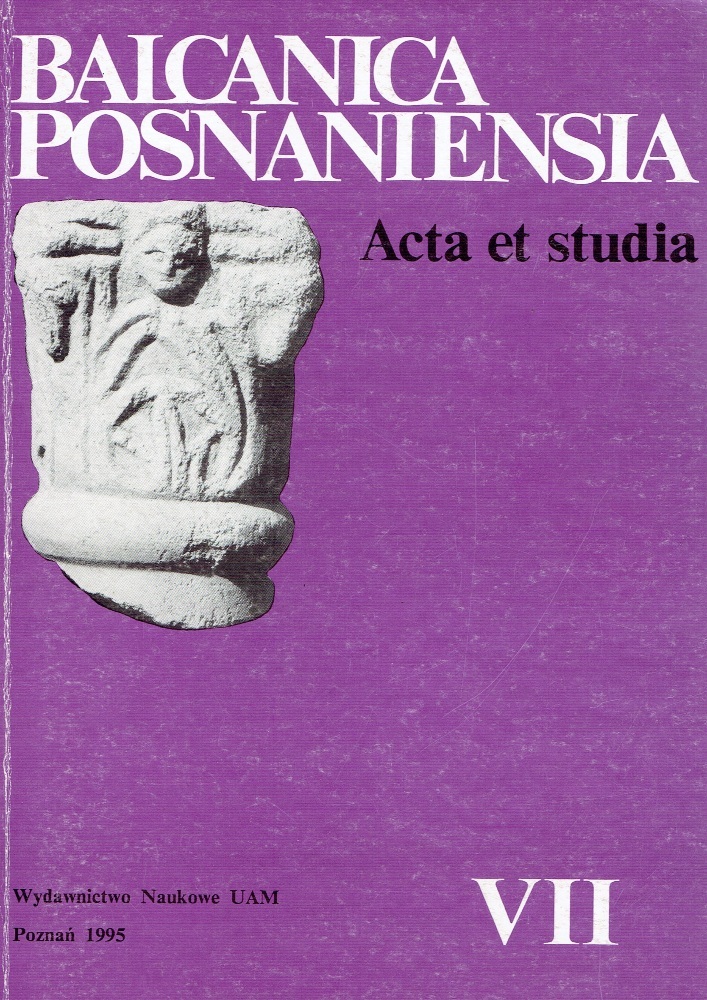
The article is devoted to the analysis of a fragmentarily preserved stone sculpture discovered in 1982 during excavations at Novae. The author identifies this monument as an element of a water installation — the so-called water steps used to channel water in fountains. The description of the monument constitutes the starting point of the analysis. The preserved fragment resembles the lower part of a throne, yet structural details—such as seven steps between the side walls and decorative elements (including stylized bird claws)—indicate a different function. As follows from the drawing on page 230, the steps formed a cascading structure down which water could flow. The archaeological context of the find is of key importance. The object was found beneath the floor of a later Christian basilica, which indicates that it was secondarily reused as building material. Other water installations were also discovered nearby, including a nymphaeum and rooms connected with water supply and thermal systems. This suggests that the sculpture originally belonged to an architectural complex associated with water. The author compares the monument to known examples of cascade fountains from the Roman Empire, in which water flowed over stepped surfaces. In contrast to more complex constructions known from Rome or Aquileia, the object discussed represents a simpler form—probably part of a small nymphaeum. The conclusion is an interpretation of the sculpture as a functional and decorative element of a water installation set in a niche above a basin. The article emphasizes the significance of the find for the reconstruction of water architecture at Novae and for research on the adaptation of elements of Roman material culture in the provinces.
References
Balil A., Fuentes y fontanas romanas de la Península Ibérica [w:] Segovia y la arqueología romana, Barcelona 1977, s. 87–89.
Giuliano A. (red.), Museo Nazionale Romano. Sculture, t. 1, cz. 3, Roma 1982.
La Rocca E., de Vos M., de Vos A., Coarelli F. (red.), Guida archeologica di Pompei, Roma 1976.
Majewski K. (red.), Novae – Sektor Zachodni 1975, „Archeologia” 1977 (1978), t. 28, s. 177.
Olczak J., Biernacki A., Kotecki J., Herbich T., Rejon Forum – Odcinek X [w:] S. Parnicki-Pudełko (red.), Novae – Sektor Zachodni 1974, cz. 1, Poznań 1978, s. 105–106.
Parnicki-Pudełko S., Rejon Forum – Odcinek X [w:] S. Parnicki-Pudełko (red.), Novae – Sektor Zachodni 1976, Poznań 1981, s. 73–118.
Richter G. M. A., The Furniture of the Greeks, Etruscans and Romans, London 1966.
License
© by Adam Mickiewicz University, Faculty of History, Poznań, 1995
OPEN ACCESS