
Keywords
Mithraism
Moesia Inferior
Thrace
iconography
Roman army
chronology of monuments
How to Cite
Abstract
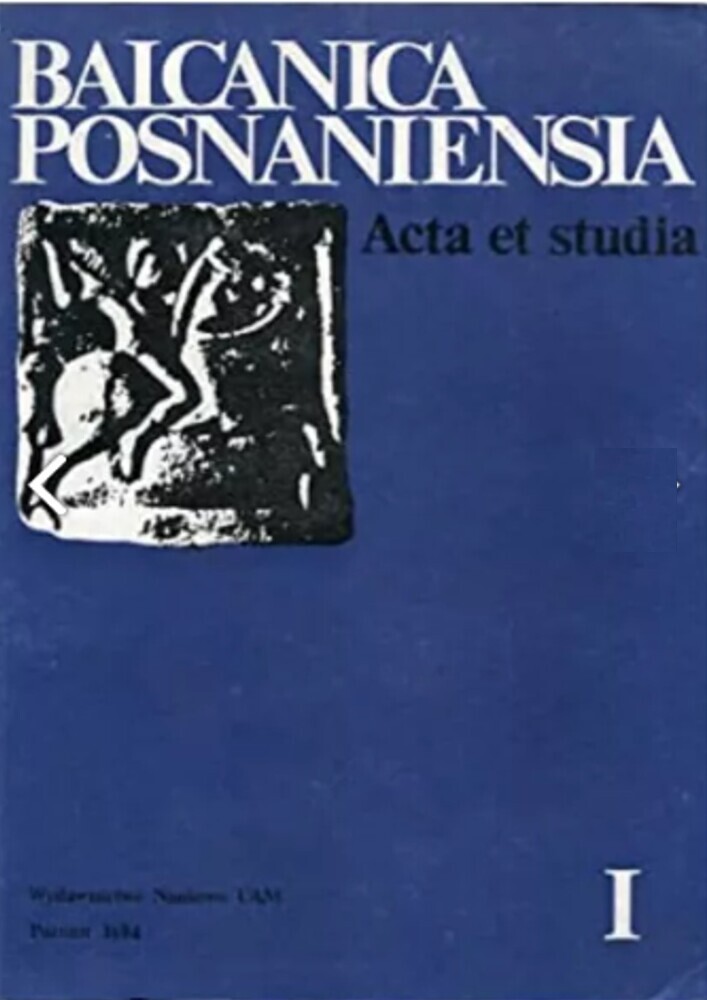
The author addressed the problem of the chronology of monuments related to the cult of Mithra - a deity originating from the Iranian tradition - discovered in Lower Moesia and Thrace. The aim of the article is to organize the archaeological material and determine the time of the appearance and development of Mithraism in the Danube provinces. The author used historical, archaeological and iconographic methods. She analysed sculptural monuments, reliefs, inscriptions and epigraphic data, comparing them with material from other provinces of the Roman Empire. The author discussed the most important types of representations of Mithras and their connections with cult centres in Phrygia, Cappadocia and Italy. She presented the development of Mithraic iconography and showed that the oldest monument of this type discovered in Bulgarian lands dates back to the beginning of the 2nd century. The analysis of the material indicates that the main propagator of the cult was the Roman army, especially the legions stationed on the lower Danube. The development of the cult of Mithras was closely related to the organisation of the Roman defence system. The discussed research results allow us to better determine the pace of the spread of Mithraism and its importance in the religious life of the Danube provinces in the 2nd and 3rd centuries AD.
References
Becatti G., Scavi di Ostia, Roma 1954.
Campbell L., Typology of Mithraic Tauroctones, „Berytus” 1954, t. 11, s. 17–60.
Cumont F., Textes et monuments figurés relatifs aux mystères de Mithra (MMM), Bruxelles 1899.
Najdenova V., La propagation des cultes orientaux en Bulgarie, [w:] Actes du Premier Congrès International des Études Balkaniques et Sud-Est Européennes, red. M. Berza, Sofia 1970, s. 177–180.
Najdenova V., Mithraic Studies in Bulgaria, „Journal of Mithraic Studies” 1976, t. 1, z. 1, s. 99–103.
Najdenova V., The Cult of Juppiter Dolichenus in Lower Moesia and Thrace, „Bulgarian Historical Review” 1977, t. 1, s. 69–82.
Patsch C., Der Kampf um den Donauraum unter Domitian und Traian, Wien 1937.
Saria B., Razvitak mitrejske kultne slike u dunavskim oblastima, „Starinar” 1923, ser. 2, t. 3, s. 33–88.
Squarciapino M., I culti orientali ad Ostia, Leiden 1962. DOI: https://doi.org/10.1163/9789004296107
Squarciapino M., The Ostian Mithraeum, [w:] Mithraism in Ostia: Mystery Religion and Christianity in the Ancient Port of Rome, red. S. Laeuchli, Evanston 1967, s. 9–21.
Vermaseren M., Corpus Inscriptionum et Monumentorum Religionis Mithriacae, Nijhoff 1960, nr 2237.
Vermaseren M., Mithras, the Secret God, London 1963.
Zlatkovskaja T., Mezija v I–II vekah našej ery, Moskva 1951.
License
Copyright
© by Adam Mickiewicz University, Faculty of History, Poznań, 1984
OPEN ACCESS