
Abstract
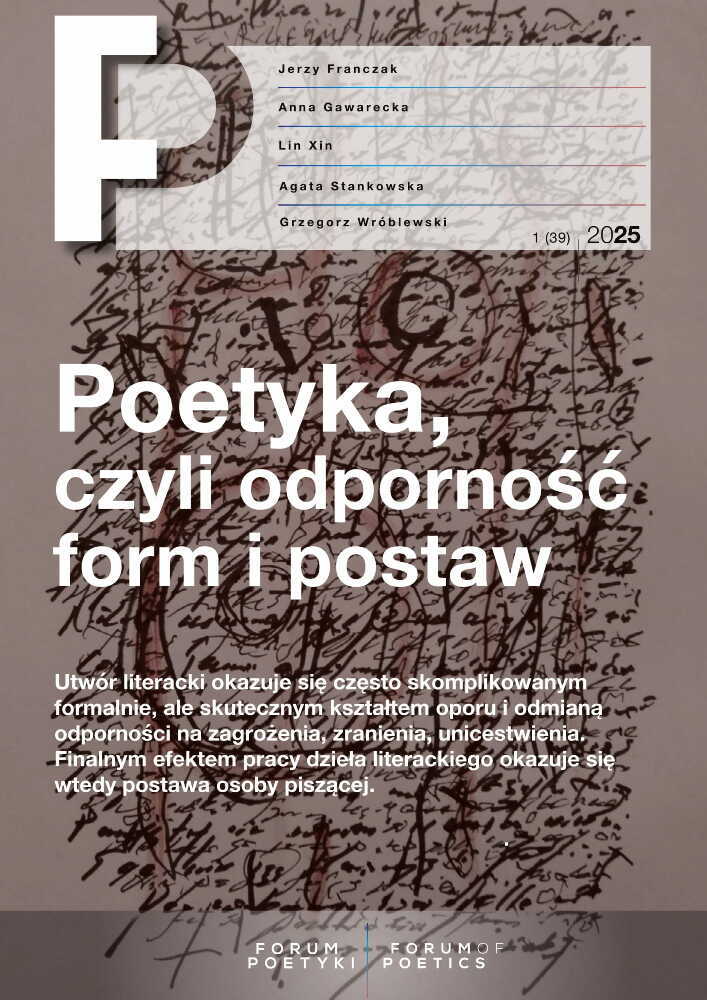
Asemic writing is an art form that combines visual and poetic elements to create new textual and visual structures. The genre has been developed independently by many artists, drawing inspiration from the avant-garde, Dadaism, Lettrism, concrete poetry, and calligraphy. It challenges the traditional understanding of writing as a carrier of meaning, rejecting culturally established symbols such as letters and numbers. Instead, artists create unique systems of signs and gestures that are specific to a given work and individual. This art form is independent of content, emphasizing the role of the creative process, expression, and the materiality of writing. Asemic works embrace randomness, errors, and unique features of handwriting. Asemic writing is constantly growing as a genre. It continues to explore new forms of expression, ways of interacting with the recipient, and emotional development. Asemic writing experiments with form and content, crossing cultural and linguistic boundaries.
References
An Anthology of Asemic Handwriting. Red. Tim Gaze, Michael Jacobson. New York: Punctum Books, 2013.
Ely, Timothy C. „Access to a Book That Won’t Open. Interview by Steve Clay”. W tegoż: The Flight into Egypt: Binding the Book, San Francisco: Chronicle Books, 1995: https://www.granarybooks.com/pdfs/ely_supp.pdf
Flusser, Vilém. Does Writing Have a Future? Tłum. Nancy Ann Roth. Minneapolis, London: University of Minnesota Press, 2011. DOI: https://doi.org/10.5749/minnesota/9780816670222.001.0001
Ingarden, Roman. „Formy poznawania dzieła literackiego”. Pamiętnik Literacki 33 (1936): 163–192.
Ingold, Tim. Lines: A Brief History. New York: Routledge, 2007. DOI: https://doi.org/10.4324/9780203961155
Konnikova, Maria. „What’s Lost as Handwriting Fades”, New York Times (2014): https://www.nytimes.com/2014/06/03/science/whats-lost-as-handwriting-fades.html
Schwenger, Peter. Asemic. The Art of Writing. Minneapolis: University of Minnesota Press, 2019. DOI: https://doi.org/10.5749/j.ctvthhd18
Skaggs, Steven. „The highly semi processes od asemic writing”. Cognitio 2 (2020): 335–349. DOI: https://doi.org/10.23925/2316-5278.2020v21i2p335-349
Winston, Christine N., Nazneen Mogrelia. „The Therapeutic Value of Asemic Writing: A Qualitative Exploration”. Journal of Creativity in Mental Health 11 (2016): 142–156. DOI: https://doi.org/10.1080/15401383.2016.1181019
Wróblewski, Grzegorz. „Asemic writing?”. Biblioteka. Magazyn Literacki, 8.12.2014. Dostęp online: https://www.biuroliterackie.pl/biblioteka/cykle/asemic-writing/.
License
Copyright (c) 2025 Olga Wyszyńska

This work is licensed under a Creative Commons Attribution-NonCommercial-NoDerivatives 4.0 International License.
Authors of articles are responsible for securing the rights to other publications (texts, tables, drawings and other illustrations) quoted or reproduced in their texts.