
Keywords
higher education
evaluation of research
How to Cite




Number of views: 671
Number of downloads: 431
Abstract
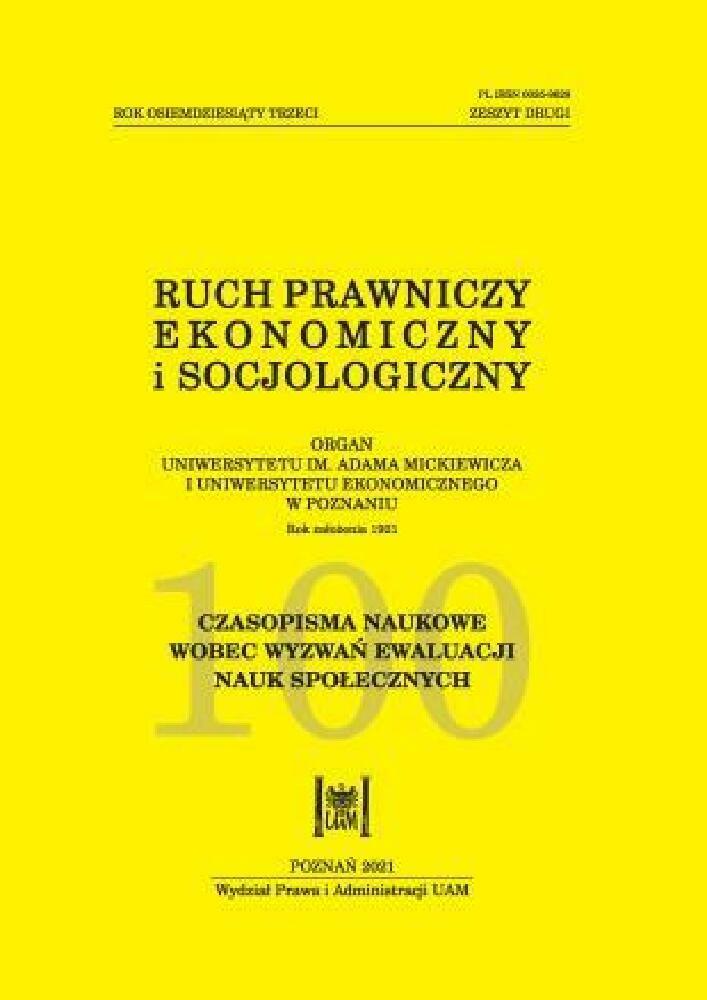
The Law on Higher Education and Science adopted by the Polish parliament in July 2018 made extensive changes to the model of the institutional evaluation of research. The evaluated output consists mainly of papers published in scientific journals. In principle, the journals eligible for the evaluation procedure are those indexed in Scopus or WoS. The official Polish ranking of journals should reflect the metrics from these databases. The statutory enlargement of bibliometric data on the evaluation of legal papers constitutes a fundamental breach in the history of Polish legal journals. The article deals with a few questions: how representative is the application of the bibliometrics for legal publications? Is the Polish ranking of legal journals consistent with the evaluation practices in other countries? What is unique in the caesura in the history of Polish legal journals marked by the law from 2018, when compared to earlier turning points in this history? What recommendations to change the evaluation legal journals in Poland are justified? The author sees the evaluation of legal journals focused on Scopus and WoS as an unwanted revolution. Using comparative, historical and pragmatical arguments, he recommends the transformation of the revolution into evolutive modifications. This reasonable evolution should be based on two things. Firstly, replacing bibliometric evaluation with expert evaluation. Secondly, more legal journals should be eligible in the evaluation process: journals indexed in ERIH+ and HeinOnline, and journals included in the official journal lists of countries other than Poland, should be taken into account.
References
Banfi, A. (2012). Aspetti critici dell’uso di rankings di riviste nelle scienze umane. ASTRID Rasegna 4(153): 1–6.
Banfi, A. (2012a). Sulle liste di riviste per le abilitazioni: un esperimento mal riuscito perché mal progettato. ASTRID Rasegna 17(166): 1–14.
Banfi, A. (2014). Diamo i numeri all scienze umane? Rischi e opportunità, [w:] A. Baffi, E. Franzini, P. Galimberti (ed.), Non spartare sull’umanista. Milano: 69–112.
Brauneder, W. (2006). Juristische Fachzeitschriften in Österreich/Cisleithanien als Zeichen rechtlicher Zäsuren in der Zweiten Hälfte des 19. Jahrhunderts, [w:] T. Simon, M. Stolleis (Hrsg.), Juristische Zeitschriften in Europa. Frankfurt am Main: 287–308.
Cooper, S., Poletti, A. (2011). The new ERA of journal ranking. The consequences of Australia’s fraught encounter with ‘quality’. Australian Universities’ Review 53(1): 57–65.
Costa, D. (2019). Evaluation of academic legal publications in France, [w:] R. van Gestel, A. Lienhard (eds.), Evaluating Academic Legal Research in Europe: The Advantage of Lagging Behind, Cheltenham UK, Northampton, MA, USA: 265–293.
Delgado López-Cózar, E., Robinson-García, N. (2014). The Google Scholar experiment: how to index false papers and manipulate bibliometric indicators. Journal of the American Society for Information Science and Technology 65(3): 446–454.
de Freitas, W. (2011). Why the ERA had to change and what we should do next: <https://theconversation.com/why-the-era-had-to-change-and-what-we-should-do-next-1874> [dostęp: 15.12.2020].
Garfield, E., Sher, I.H. (1963). New factors in the evaluation of scientific literature through citation indexing. American Documentation 14(8): 195–201.
Gross, P., Gross, E. (1927). College libraries and chemical education. Science 66: 385–389.
Havemann, F. (2009). Einführung in die Bibliometrie. Berlin.
Hojnik, J. (2019). Evaluation of academic legal publications in Slovenia, [w:] R. van Gestel, A. Lienhard (eds.), Evaluating Academic Legal Research in Europe: The Advantage of Lagging Behind. Cheltenham, UK, Northampton, MA, USA: 341–383.
Holmes, O. (1881). The Common Law. Boston.
Mac Sithigh, D. (2019). Evaluation of academic legal publications in the United Kongdom, [w:] R. van Gestel, A. Lienhard (eds.), Evaluating Academic Legal Research in Europe: The Advantage of Lagging Behind, Cheltenham UK, Northamption, MA, USA: 20–55.
Maier, E. (2019). Evaluation of academic legal publications in Austria, [w:] R. van Gestel, A. Lienhard (eds.), Evaluating Academic Legal Research in Europe: The Advantage of Lagging Behind. Cheltenham UK, Northamption, MA, USA: 104–141.
Milewski, S., Redzik, A. (2011). Themis i Pheme. Czasopiśmiennictwo prawnicze w Polsce do 1939 roku. Warszawa.
Pendlebury, D.A. (2020): When the data don’t mean what they say: Japan’s comparative underperformance in citation impact, [w:] C. Daraio, W. Glänzel (eds.), Evaluative Informetrics: The Art of Metrics-Based Research, Cham 2020: 115–143.
Peruginelli, G. (2015). Evaluating research: the case of legal scholarly output. Legal Information Management 15: 50–56.
Pomianowski, P.Z. (2015). Początki polskiego czasopiśmiennictwa prawniczego. Seria pierwsza „Themis Polskiej”. Warszawa.
Purnhagen, K., Petersen, N. (2019). Evaluation of academic legal publications in Germany, [w:] R. van Gestel, A. Lienhard (eds.), Evaluating Academic Legal Research in Europe: The Advantage of Lagging Behind. Cheltenham UK, Northamption, MA, USA: 88–103.
Simon, T., Stolleis, M. (2006). Juristische Zeitschriften in Europa, [w:] T. Simon, M. Stolleis (Hrsg.), Juristische Zeitschriften in Europa. Frankfurt am Main: 1–13.
Whitley, R. (2007). Changing governance of the public sciences, [w:] R. Withley, J. Gläser (eds.), The Changing Governance of the Sciences: The Advent of Research Evaluation Systems. Dordrecht: 3–27.
Wieczyński, G. (2020). Problemy oceny parametrycznej polskich czasopism naukowych z dziedziny nauk prawnych. Państwo i Prawo 75(9): 3–22.
Wrona, G. (2013). Rec.: Stanisław Milewski, Adam Redzik, Themis i Pheme. Czasopiśmiennictwo prawnicze w Polsce do 1939 roku, Wydawnictwo Iskry, Warszawa 2011, ss. 658. Rocznik Historii Prasy Polskiej 16(1): 213–218.
License
Copyright (c) 2021 WPiA UAM

This work is licensed under a Creative Commons Attribution-NonCommercial-NoDerivatives 4.0 International License.