
Keywords
second language acquisition (SLA)
theoretical diversification
methodological improvement
pedagogical innovation
How to Cite



Number of views: 877
Number of downloads: 580
Abstract
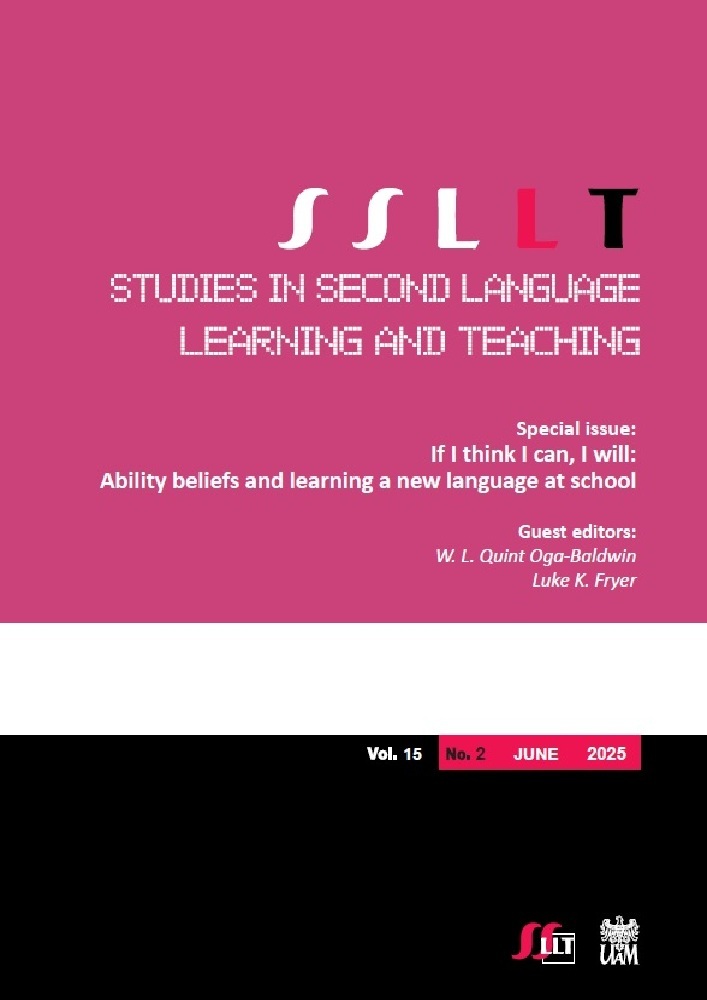
In this article, we highlight the important achievements of the editors and contributors in this special issue. We argue that this collection of studies on individual differences (IDs) advances the field in terms of theoretical diversification, methodological improvement, and pedagogical innovation. We also contend that a renewed interest in ID research will enable second language acquisition (SLA) researchers and language educators to show how language education helps language learners acquire desirable attributes and dispositions. In turn, related findings will enable researchers and educators to articulate the value of language learning for the public as many language educators may fear that generative artificial intelligence and translation tools will remove a major motivation for learning languages.
References
Alamer, A., & Lee, J. (2021). Language achievement predicts anxiety and not the other way around: A cross-lagged panel analysis approach. Language Teaching Research, 28(4), 1-22. DOI: https://doi.org/10.1177/13621688211033694
Atkinson, D. (2011). A sociocognitive approach to second language acquisi-tion: How mind, body, and world work together in learning additional languages. In D. Atkinson (Ed.), Alternative approaches to second language acquisition (pp. 142-166). Routledge. DOI: https://doi.org/10.4324/9780203830932
Barac, R., Bialystok, E., Castro, D., & Sanchez, M. (2014). The cognitive development of young dual language learners: A critical review. Early Childhood Research Quarterly, 29, 699-714. DOI: https://doi.org/10.1016/j.ecresq.2014.02.003
Baum, S., & Titone, D. (2014). Moving towards a neuroplasticity view of bilingualism, executive control, and aging. Applied Psycholinguistics, 35, 921-925. DOI: https://doi.org/10.1017/S0142716414000174
Benson, P., & Cooker, L. (2013). The social and the individual in applied linguistics research. In P. Benson & L. Cooker (Eds.), The applied linguistic individual: Sociocultural approaches to identity, agency and autonomy (pp. 1-16). Equinox.
Bialystok, E. (2021). Bilingualism: Pathway to cognitive reserve. Trends in Cognitive Sciences, 25(5), 355-364. DOI: https://doi.org/10.1016/j.tics.2021.02.003
Bialystok, E., Craik, F. I., & Freedman, M. (2007). Bilingualism as a protection against the onset of symptoms of dementia. Neuropsychologia, 45, 459-464. DOI: https://doi.org/10.1016/j.neuropsychologia.2006.10.009
Bialystok, E., Craik, F. I., & Luk, G. (2012). Bilingualism: Consequences for mind and brain. Trends in Cognitive Sciences, 16(4), 240-250. DOI: https://doi.org/10.1016/j.tics.2012.03.001
Bjork, E. L., & Bjork, R. A. (2011). Making things hard on yourself, but in a good way: Creating desirable difficulties to enhance learning. In M. A. Gernsbacher, R. W. Pew, L. M. Hough, & J. R. Pomerantz (Eds.), Psychology and the real world: Essays illustrating fundamental contributions to society (pp. 56-64). Worth.
Bokander, B. (2022). Psychometric assessments. In S. Li, P. Hiver, & M. Papi (Eds.), The Routledge handbook of second language acquisition and individual differences (pp. 454-465). Taylor & Francis. DOI: https://doi.org/10.4324/9781003270546-36
Boudreau, C., MacIntyre, P. D., & DeWaele, J. (2018). Enjoyment and anxiety in second language communication: An idiodynamic approach. Studies in Second Language Learning and Teaching, 8(1), 147-170. DOI: https://doi.org/10.14746/ssllt.2018.8.1.7
Burston, J. (2014). MALL: The pedagogical challenges. Computer Assisted Language Learning, 27(4), 344-357. DOI: https://doi.org/10.1080/09588221.2014.914539
Calabria, M., Hernández, M., Cattaneo, G., Suades, A., Serra, M., Juncadella, M., Reñé, M., Sala, I., Lleó, A., Ortiz-Gil, J., Ugas, L., Ávila, A., Gómez Ruiz, I., Ávila, C., & Costa, A. (2020). Active bilingualism delays the onset of mild cognitive impairment. Neuropsychologia, 146, 107528. DOI: https://doi.org/10.1016/j.neuropsychologia.2020.107528
Chomsky, N., Roberts, I., & Watumull, J. (2023, March 8). Noam Chomsky: The false promise of ChatGPT. The New York Times. https://www.nytimes.com/2023/03/08/opinion/noam-chomsky-chatgpt-ai.html
Cohen, A. D. (2014). Strategies in learning and using a second language. Routledge. DOI: https://doi.org/10.4324/9781315833200
Crowther, D., Kim, S., Lee, J., Lim, J., & Loewen, S. (2021). Methodological synthesis of cluster analysis in second language research. Language Learning, 71, 99-130. DOI: https://doi.org/10.1111/lang.12428
Dörnyei, Z. (2014). The psychology of the language learner: Individual differences in second language acquisition. Routledge. DOI: https://doi.org/10.4324/9781410613349
Dörnyei, Z., & Skehan, P. (2003). Individual differences in second language learning. In C. J. Doughty & M. H. Long (Eds.), The handbook of second language acquisition (pp. 589-630). Blackwell. DOI: https://doi.org/10.1002/9780470756492.ch18
Doughty, C. J. (2019). Cognitive language aptitude. Language Learning, 69(S1), 101-126. DOI: https://doi.org/10.1111/lang.12322
Douglas Fir Group. (2016). A transdisciplinary framework for SLA in a multi-lingual world. Modern Language Journal, 100(S1), 19-47. DOI: https://doi.org/10.1111/modl.12301
Duff, P. A. (2019). Social dimensions and processes in second language acquisition: Multilingual socialization in transnational contexts. Modern Language Journal, 103(S1), 6-22. DOI: https://doi.org/10.1111/modl.12534
Eccles, J. S., & Wigfield, A. (2020). From expectancy-value theory to situated expectancy-value theory: A developmental, social cognitive, and sociocultural perspective on motivation. Contemporary Educational Psychology, 61, 101859. DOI: https://doi.org/10.1016/j.cedpsych.2020.101859
Ehrman, M. E., Leaver, B., & Oxford, R. L. (2003). A brief overview of individual differences in second language learning. System, 31(3), 313-330. DOI: https://doi.org/10.1016/S0346-251X(03)00045-9
Ellis, N. C. (2019). Essentials of a theory of language cognition. Modern Language Journal, 103 (Supplement 2016), 39-60. DOI: https://doi.org/10.1111/modl.12532
Engel de Abreu, P., Cruz-Santos, A., Touringo, C., Martin, R., & Bialystok, E. (2012). Bilingualism enriches the poor: Enhanced cognitive control in low-income minority children. Psychological Science, 23, 1364-1371. DOI: https://doi.org/10.1177/0956797612443836
Fryer, L. K., & Oga-Baldwin, W. L. Q. (2019). Succeeding at junior high school: Students’ reasons, their reach and the teaching that h(inders)elps their grasp. Contemporary Educational Psychology, 59, 101778. DOI: https://doi.org/10.1016/j.cedpsych.2019.101778
Gao, X. (2007). Has language learning strategy research come to an end? A response to Tseng et al. (2006). Applied Linguistics, 28(4), 615-620. DOI: https://doi.org/10.1093/applin/amm034
Gao, X. (2024). Language education in a brave new world: A dialectical imagination. Modern Language Journal, 108(2), 556-562. DOI: https://doi.org/10.1111/modl.12930
Gao, X., & Yang, W. (2023). Multilingualism and language teacher education. System, 118, 103-127. DOI: https://doi.org/10.1016/j.system.2023.103127
Gardner, R. C., & MacIntyre, P. D. (1993). On the measurement of affective variables in second language learning. Language Learning, 43(2), 157-194. DOI: https://doi.org/10.1111/j.1467-1770.1992.tb00714.x
Gregersen, T., & MacIntyre, P. (2014). Capitalizing on language learners’ individuality: From premise to practice. Multilingual Matters. DOI: https://doi.org/10.21832/9781783091218
Griffiths, C., & Soruç, A. (2020). Individual differences in language learning. Springer International Publishing. DOI: https://doi.org/10.1007/978-3-030-52900-0
Jiang, M. Y. C., Jong, M. S. Y., Lau, W. W. F., Chai, C. S., & Wu, N. (2023). Ef-fects of automatic speech recognition technology on EFL learners’ willingness to communicate and interactional features. Educational Technology & Society, 26(3), 37-52.
Kern, R. (2024). Twenty-first century technologies and language education: Charting a path forward. Modern Language Journal, 108(2), 515-533. DOI: https://doi.org/10.1111/modl.12924
Kidd, E., Donnelly, S., & Christiansen, M. H. (2018). Individual differences in language acquisition and processing. Trends in Cognitive Sciences, 22(2), 154-169. DOI: https://doi.org/10.1016/j.tics.2017.11.006
Kroll, J. F., & Dussias, P. E. (2017). The benefits of multilingualism to the personal and professional development of residents of the US. Foreign Language Annals, 50(2), 248-259. DOI: https://doi.org/10.1111/flan.12271
Li, S., Hiver, P., & Papi, M. (Eds.). (2022). The Routledge handbook of second language acquisition and individual differences. Taylor & Francis. DOI: https://doi.org/10.4324/9781003270546
Locke, E. A., & Latham, Gary P. (1990). A theory of goal setting and task performance. Prentice Hall.
Luo, X., & Wei, R. (2021). Is multilingualism linked to a higher tolerance of homosexuality? Evidence from a national survey. Journal of Multilingual and Multicultural Development, 45(2), 196-208. DOI: https://doi.org/10.1080/01434632.2021.1874002
Morgana, A., & Kukulska-Hulme, A. (Eds.). (2021). Mobile assisted language learning across educational context. Routledge. DOI: https://doi.org/10.4324/9781003087984
Oga-Baldwin, W. L. Q., Fryer, L. K., & Larson-Hall, J. (2019). The critical role of the individual in language education: New directions from the learning sciences. System, 86, 102-118. DOI: https://doi.org/10.1016/j.system.2019.102118
Pawlak, M. (Ed.). (2021). Investigating individual learner differences in second language learning. Springer. DOI: https://doi.org/10.1007/978-3-030-75726-7
Pawlak, M., & Kruk, M. (2022). Individual differences in computer assisted language learning research. Routledge. DOI: https://doi.org/10.4324/9781003240051
Pawlak, M., Csizér, K. K., & Soto, A. (2020). Interrelationships of motivation, self-efficacy and self-regulatory strategy use: An investigation into study abroad experiences. System, 93, 102300. DOI: https://doi.org/10.1016/j.system.2020.102300
Perani, D., Farsad, M., Ballarini, T., Lubian, F., Malpetti, M., Fracchetti, A., Magnani, G., March, A., & Abutalebi, J. (2017). The impact of bilingualism on brain reserve and metabolic connectivity in Alzheimer’s dementia. Proceedings of the National Academy of Sciences, 114, 1690-1695. DOI: https://doi.org/10.1073/pnas.1610909114
Stockwell, G. (2021). Mobile assisted language learning: Concepts, contexts and challenges. Cambridge University Press. DOI: https://doi.org/10.1017/9781108652087
Turker, S., Seither-Preisler, A., & Reiterer, S. M. (2021). Examining individual differences in language learning: A neurocognitive model of language aptitude. Neurobiology of Language, 2(3), 389-415. DOI: https://doi.org/10.1162/nol_a_00042
Ushioda, E. (2009) A person-in-context relational view of emergent motivation, self and identity. In Z. Dörnyei & E. Ushioda (Eds.), Motivation, language identity, and the L2 self (pp. 215-228). Multilingual Matters. DOI: https://doi.org/10.21832/9781847691293-012
Wei, R., Kang, Y., & Wang, S. (2022). The relationship between tolerance of ambiguity and multilingualism revisited. System, 107, 102798. DOI: https://doi.org/10.1016/j.system.2022.102798
Wenden, A. L. (2002). Learner development in language learning. Applied Linguistics, 23(1), 32-55. DOI: https://doi.org/10.1093/applin/23.1.32
Yang, W., & Gao, X. (2022). Review of mobile assisted language learning: Concepts, contexts and challenges. Language Learning & Technology, 26(1).
License
Copyright (c) 2025 Weijia Yang, Xuesong (Andy) Gao

This work is licensed under a Creative Commons Attribution 4.0 International License.
1.1 The Author hereby warrants that he/she is the owner of all the copyright and other intellectual property rights in the Work and that, within the scope of the present Agreement, the paper does not infringe the legal rights of another person. The owner of the copyright work also warrants that he/she is the sole and original creator thereof and that is not bound by any legal constraints in regard to the use or sale of the work.
1.2. The Publisher warrants that is the owner of the PRESSto platform for open access journals, hereinafter referred to as the PRESSto Platform.
2. The Author grants the Publisher non-exclusive and free of charge license to unlimited use worldwide over an unspecified period of time in the following areas of exploitation:
2.1. production of multiple copies of the Work produced according to the specific application of a given technology, including printing, reproduction of graphics through mechanical or electrical means (reprography) and digital technology;
2.2. marketing authorisation, loan or lease of the original or copies thereof;
2.3. public performance, public performance in the broadcast, video screening, media enhancements as well as broadcasting and rebroadcasting, made available to the public in such a way that members of the public may access the Work from a place and at a time individually chosen by them;
2.4. inclusion of the Work into a collective work (i.e. with a number of contributions);
2.5. inclusion of the Work in the electronic version to be offered on an electronic platform, or any other conceivable introduction of the Work in its electronic version to the Internet;
2.6. dissemination of electronic versions of the Work in its electronic version online, in a collective work or independently;
2.7. making the Work in the electronic version available to the public in such a way that members of the public may access the Work from a place and at a time individually chosen by them, in particular by making it accessible via the Internet, Intranet, Extranet;
2.8. making the Work available according to appropriate license pattern Attribution 4.0 International (CC BY 4.0) as well as another language version of this license or any later version published by Creative Commons.
3. The Author grants the Publisher permission to reproduce a single copy (print or download) and royalty-free use and disposal of rights to compilations of the Work and these compilations.
4. The Author grants the Publisher permission to send metadata files related to the Work, including to commercial and non-commercial journal-indexing databases.
5. The Author represents that, on the basis of the license granted in the present Agreement, the Publisher is entitled and obliged to:
5.1. allow third parties to obtain further licenses (sublicenses) to the Work and to other materials, including derivatives thereof or compilations made, based on or including the Work, whereas the provisions of such sub-licenses will be the same as with the Attribution 4.0 International (CC BY 4.0) Creative Commons sub-license or another language version of this license, or any later version of this license published by Creative Commons;
5.2. make the Work available to the public in such a way that members of the public may access the Work from a place and at a time individually chosen by them, without any technological constraints;
5.3. appropriately inform members of the public to whom the Work is to be made available about sublicenses in such a way as to ensure that all parties are properly informed (appropriate informing messages).
6. Because of the royalty-free provision of services of the Author (resulting from the scope of obligations stipulated in the present Agreement), the Author shall not be entitled to any author’s fee due and payable on the part of the Publisher (no fee or royalty is payable by the Publisher to the Author).
7.1. In the case of third party claims or actions for indemnity against the Publisher owing to any infractions related to any form of infringement of intellectual property rights protection, including copyright infringements, the Author is obliged to take all possible measures necessary to protect against these claims and, when as a result of legal action, the Publisher, or any third party licensed by the Publisher to use the Work, will have to abandon using the Work in its entirety or in part or, following a court ruling in a legal challenge, to pay damages to a third party, whatever the legal basis
7.2. The Author will immediately inform the Publisher about any damage claims related to intellectual property infringements, including the author’s proprietary rights pertaining to a copyrighted work, filed against the Author. of liability, the Author is obliged to redress the damage resulting from claims made by third party, including costs and expenditures incurred in the process.
7.3. To all matters not settled herein provisions of the Polish Civil Code and the Polish Copyright and Related Rights Act shall apply.