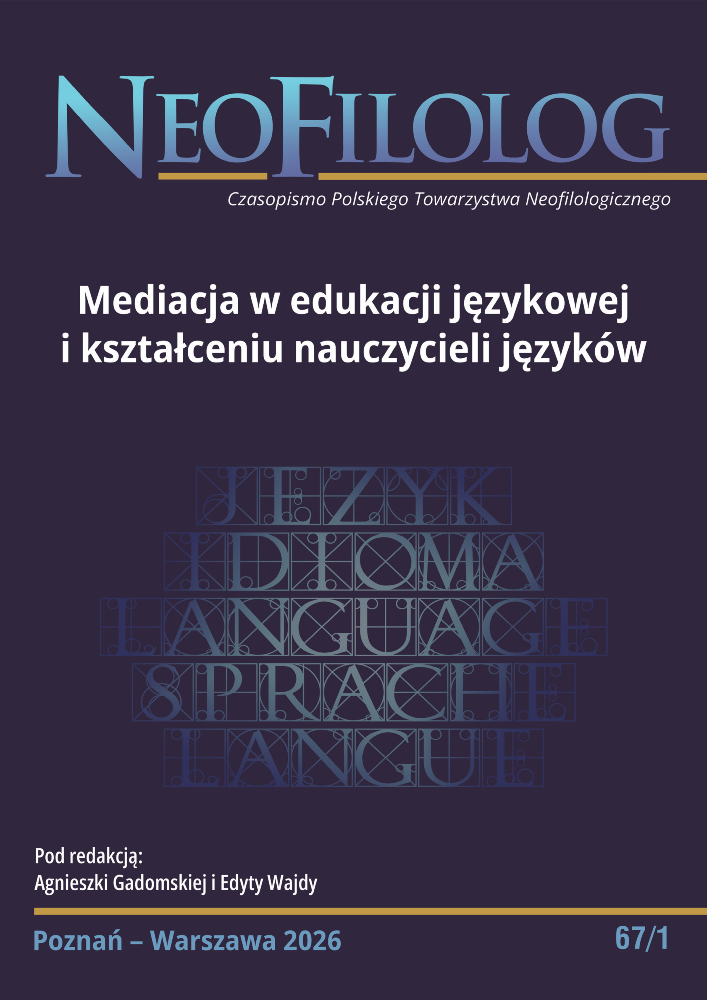
Aktualny numer
Kwartalnik Neofilolog to recenzowane (double-blind) czasopismo naukowe wydawane przez Polskie Towarzystwo Neofilologiczne. Ukazuje się w wersji papierowej systematycznie od 1930 roku (z przerwą w latach 1940–1989), a od 2009 roku również w wersji elektronicznej. Jego głównym celem jest poszerzanie wiedzy o procesie nauczania i uczenia się języków nowożytnych, także w wymiarze społecznym i kulturowym, ujmowanym zarówno z perspektywy teoretycznej i/lub teoretyczno-praktycznej, jak i metodologicznej. Czasopismo ukazuje się cztery razy do roku w postaci jednorodnych tematycznie numerów, związanych z tematyką dorocznych konferencji Towarzystwa. Są one publikowane na koniec kwartału (marzec, czerwiec, wrzesień, grudzień). Ponadto jeden lub dwa tomy w roku poświęcone są wybranej problematyce związanej z aktualnymi tendencjami w zakresie językoznawstwa, glottodydaktyki i akwizycji języków. Artykuły ukazują się w języku polskim, angielskim, niemieckim, francuskim i hiszpańskim.
INDEKSOWANE W:
SCOPUS, DOAJ, Sherpa Romeo, Polska Bibliografia Naukowa, INDEX COPERNICUS INTERNATIONAL - IC Journals Master List, Biblioteka Nauki, CEJSH, CEON, Arianta, ERIH PLUS, PKP INDEX, EBSCO, Google Scholar, WIKIDATA, CROSSREF, SUDOC, SHERPA ROMEO, OPENALEX, EZB
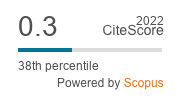
WSKAŹNIKI OCENY CZASOPISMA:

Punktacja Ministerstwa Edukacji i Nauki (2024): 70
INDEX COPERNICUS ICV (2018): 92.75
INDEX COPERNICUS ICV (2019): 94.56
INDEX COPERNICUS ICV (2020): 100.00
INDEX COPERNICUS ICV (2021): 100.00
INDEX COPERNICUS ICV (2022): 100.00
INDEX COPERNICUS ICV (2023): 121.86
INDEX COPERNICUS ICV (2024): 121.00
DOI: 10.14746/n
ISSN (Print): 1429-2173
ISSN (Online): 2545-3971 - wersja pierwotna
PRACE PUBLIKOWANE W CZASOPIŚMIE DOSTĘPNE SĄ NA LICENCJI CREATIVE COMMONS:
Uznanie autorstwa - Bez utworów zależnych 4.0 Międzynarodowe.
Ogłoszenia
Open Call for Submissions - NEOFILOLOG 2026 (No. 67/2) special issue “Examining Language Teacher Identities: Intersectionality, Tensions, Lived Experience”.
We are pleased to invite contributions to a special thematic collection entitled “Examining Language Teacher Identities: Intersectionality, Tensions, Lived Experience”.
Language teacher identity, understood from a poststructuralist approach, has been variously defined in the literature, as almost every aspect of teachers’ work may affect their identities. In poststructuralist times identity is no longer viewed as innate, determined and stable, but perceived as “neither unified nor fixed” (Weedon, 1997, p. 21), discursively constructed, changing through the use of language under temporal and spatial circumstances, “dynamic, multiple, and hybrid” (Barkhuizen, 2017, p. 4).
In recent years, scholars have increasingly recognized that understanding language teachers’ identities requires not only their identification but also investigating how teachers manage and regulate their different identities over time and place. Central to this emerging perspective is the concept of intersectionality— a way of understanding and analyzing the complexity in the world, in people, and in human experiences” (Collins & Bilge, 2016), which is better known if looked upon from a number of lenses that act together and affect each other (p. 2).
Several identity theories provide the foundation for conceptualizing teacher identity work, both in general education literature (e.g., Gee’s (2000) Identity Framework; Harré’s (2012) Positioning Theory) and SLA research (e.g., Consoli’s (2022) Life Capital Framework, Werbińska (2016) 3A LTIF) to name just a few examples. Despite the existence of relevant literature, there are still gaps in showing how teacher identities are demonstrated, negotiated, institutionally mediated across teachers’ life trajectories.
In line with this objective, we invite contributions from language teaching practitioners, researchers, and educators to consider submitting original, theoretical or empirical (e.g., mixed methods, case studies, auto/ethnographies, practice-based, reflective) studies that explore various aspects of language teacher identities. Potential topics may include but are not limited to:
- Language Teacher Identity and Institutional Practices,
- Language Teacher (De)Professionalization,
- Language Teacher Belonging, Authenticity, Resilience,
- Language Teacher Identities and New Technologies (including AI),
- Language Teacher Identities and Study Abroad,
- Language Teacher Identity and Teacher Leadership,
- Language Teacher Identity and Neoliberalism (or Neonationalism) Issues,
- Language Teacher Identities and Ageism and /or Sexism,
- Native-speakerism Issues (including Accentism).
This issue will include approximately six-to-ten articles (6,000-7,000 words inclusive of references). Please submit proposals (300-500 words) by March 1, 2025 to dorota.werbinska@upsl.edu.pl.
The abstract should include: title of the study, nature of the study (e.g., empirical, theoretical, or review), rationale and theoretical background, research questions or study aims, proposed methodology or design, expected findings and significance.
As with all submissions to NEOFILOLOG Journal, this special collection of manuscripts (issue No. 67/2) will be double-blind peer-reviewed.
We will be sharing additional information with all authors once we have received the abstracts and have a list of confirmed names.
To ensure a timely publication of this special NEOFILOLOG issue (No. 67/2), the timeline below will be followed.

References
Barkhuizen, G. (2017). Language teacher identity research: An introduction. In G. Barkhuizen (Ed.), Reflections on language teacher identity research (pp. 1–11). Routledge.
Collins, P. H., & Bilge, S. (2016). Intersectionality. Polity Press.
Consoli, S. (2022). Life capital: An epistemic and methodological lens for TESOL research. TESOL Quarterly, 56(4), 1397–1409. https://doi.org/10.1002/tesq.3154
Gee, J. P. (2000). Identity as an analytic lens for research in education. Review of Research in Education, 25(1), 99–125. https://doi.org/10.3102/0091732x025001099
Harré, R. (2012). Positioning theory: Moral dimensions of social-cultural psychology. In J. Valsiner (Ed.), The Oxford Handbook of Culture and Psychology. (pp. 191–206). Oxford, UK: Oxford University Press. https://doi.org/10.1093/oxfordhb/9780195396430.002.0004
Weedon, C. (1997). Feminist practice and poststructuralist theory. Blackwell Publishing.
Werbińska, D. (2016). Language-Teacher Professional Identity: Focus on Discontinuities from the Perspective of Teacher Affiliation, Attachment and Autonomy. In C. Gkonou, S. Mercer & T. Dieter (Eds.). New Directions in Language Learning Psychology. (pp.135–157). Springer.
Więcej…
Zaproszenie do nadsyłania artykułów do numeru tematycznego czasopisma Neofilolog
Redakcja czasopisma Neofilolog zaprasza do nadsyłania artykułów naukowych opartych na referatach wygłoszonych podczas Ogólnopolskiej Konferencji Naukowo-Dydaktycznej Polskiego Towarzystwa Neofilologicznego pt. Mediacja i działania mediacyjne w komunikacji w językach obcych, zorganizowanej we wrześniu 2025 roku przez Polskie Towarzystwo Neofilologiczne oraz Uniwersytet SWPS, Wydział Nauk Humanistycznych w Warszawie.
Zachęcamy do przygotowywania artykułów w językach kongresowych (angielskim, niemieckim, francuskim). Istnieje również możliwość publikacji tekstów w języku polskim.
Artykuły należy składać do 10 grudnia 2025 r. za pośrednictwem platformy Pressto.
Więcej…